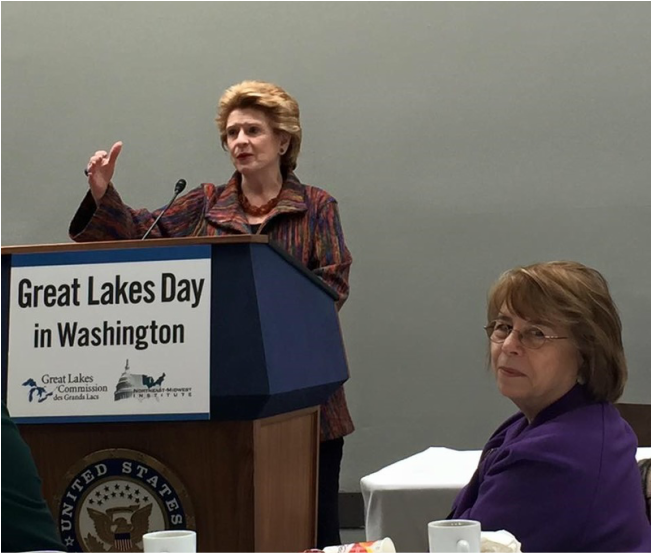
 LWVLMR Board member Judy Beck listens to remarks by Senator Debbie Stabenow from Michigan. See more photos on our Facebook page, and be sure to like us! Congratulations to the Healing Our Waters Coalition for organizing a terrific Great Lakes Days event in Washington DC. Leaguers played an important part of this group of over 100 Lake lovers who convened in February to get updates on the successes of the Great Lakes Restoration Initiative, hear speakers, and participate in in-person meetings with elected representatives and staff on Capitol Hill. One of our most effective handouts for making our case is a description of restoration successes from around the Great Lakes region, which can be accessed here .
The Great Lakes Restoration Initiative (GLRI) is an inter-agency program designed to address the most significant problems in the Great Lakes and works to protect, restore and maintain the Great Lakes Ecosystem. It has traditionally enjoyed bi-partisan support. At our Congressional breakfast both Republicans and Democrats from both Houses addressed the group in support of our work. Unfortunately, President Obama’s current budget requests only $250 million for FY 2017. We were lobbying to have that amount restored to $300 million to maintain the current level of funding because, although GLRI is showing real and measurable results, there is still plenty of work to be done. LWVLMR supports authorization and multi-year funding of $300 million per year for the GLRI and encourages you to contact your federal legislators in support of this position. The visit was timely as there is heightened concern about drinking water across the states, due to the crisis in Flint, MI. So in addition to the request for GLRI support, we were also asking for a boost to the Clean Water and Drinking Water State Revolving Fund programs that help local communities upgrade aging water infrastructure to protect drinking water, reduce sewer overflows, and prevent beach contamination. Additionally, protection against Asian carp and other invasive species coming through the Chicago Area Waterways was sought, with emphasis on speeding up the Brandon Road Feasibility study by the Army Corps of Engineers. Brandon Road is the site of a Lock and Dam on the Illinois River and was identified as a possible choke point to stop the fish in a previous study which we lobbied for. All of our Great Lakes LWV states except Pennsylvania are members of the Healing Our Waters Coalition. Their annual conference will be September 20-22, 2016 in Sandusky, OH this year and we encourage League members to attend. "If Waukesha's application were approved in its present state, it would set a terrible precedent for the entire Great Lakes region and weaken the Compact!" 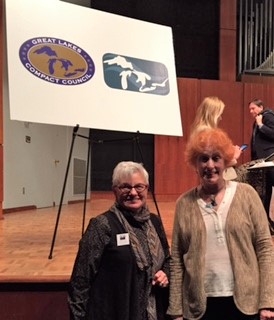 Marjorie Palleon and Claire Vanderslice at the Hearing. Marjorie Palleon and Claire Vanderslice at the Hearing. On Thursday, February 18, 2016, the Carroll University Shattuck Music Center, Room 122, was filled with hundreds of people interested and concerned about the first Great Lakes water diversion application. Busloads of people arrived from all over Wisconsin, Illinois, Michigan, Indiana, and even New York. Most were eager to state why they did not want this diversion to happen.
We arrived early to sign up to speak and observe the area. The stage was filled with 12 chairs for the Governors and Premiers or their representatives. A microphone stood ready in the center floor walkway for public hearing presenters. At 2 pm, officials from DNR and Waukesha were on stage with slide presentations. They also answered questions from the audience regarding the diversion, radium pollution and removal, wetlands, sewers, wells, conservation, alternate water sources, and more. Promptly at 3 pm, the chairperson of the Great Lakes and St. Lawrence Governors and Premiers explained the public hearing rules to the audience. No one could speak unless they had signed in, and then been called by the chairperson. The organizers decided the order. First, all 20-30 officials from mayor, alderman, city planners, water and sewer planners and individuals of Waukesha appeared, the mayors of surrounding communities, and finally well know individuals from environmental organizations such as Elizabeth Wheeler, Todd Ambs, George Meyer of WI Wildlife Federation, Karen Hobbs of NRDC, ACLU and many more. It was then 6 pm and supper break was announced. There were 75 presenters left and the Governors and Premiers stated they would stay "until they were done." Many individuals left as the buses were leaving. We also left. Our statement had been received prior to the meeting by email, and we did not know if and when we would be called. Interesting information from the presentations:
Reported by Marjorie Palleon, LWV of Ozaukee Area and LWVLMR Delegate The 2008 Great Lakes Compact protects the water resources of the Great Lakes Basin from diversions and excessive withdrawals. Diversions away from the Great Lakes may be considered under the Compact, but only under strict conditions.
Waukesha, WI, is the first community to apply for a diversion. Some of its water comes from groundwater contaminated by radium and, in 2012, Waukesha began the process of requesting permission to remove water from Lake Michigan and send it to residents and businesses located out of the watershed. A revised diversion application has been approved by the Wisconsin Department of Natural Resources and now goes to the Regional Body and the Governor's Compact Council for review. Interested individuals and organizations may submit comments through March 14, 2016. A public hearing will be held on February 18, 2016, at Carroll University in Waukesha. To read the application and learn about the review process, visit the Wisconsin DNR Waukesha Diversion webpage. NATIVE PLANTS HELP CLEAN WATER, NATURALLY!
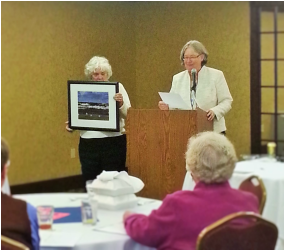
We are thrilled to have learned that we will be able to continue spreading that message with the aid of an Illinois Department of Natural Resources Coastal Management Mini-Grant! The grant will fund the development and production of outreach materials and one or more mobile workshops in summer of 2016. We are extremely grateful for this opportunity! Materials will be available for no cost to the local Leagues in the Illinois Coastal Zone, and to other LWVLMR member Leagues at cost. We look forward to working again with local Leagues on this project. More information about this project will be available early in 2016. The LWVIL Education Fund will administer the grant. This is the second coastal management grant LWVILEF and LWVLMR have received; the first funded the first phase of the Stormwater Education project through 2014. 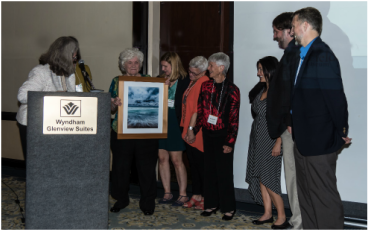 The artwork selected as this year's prize is by an Indiana artist. Some of Jeanette's family joined League members in presenting the award. The artwork selected as this year's prize is by an Indiana artist. Some of Jeanette's family joined League members in presenting the award. Indiana Delegate and LWV LaPorte Area member Jeannette Neagu was announced as the winner of the 2015 Art Palleon Advocacy Award at the League of Women Voters Annual Meeting in Glenview, Illinois. She was recognized for her decades of tireless work as an advocate for the environmental health and protection of Lake Michigan.
Jeanette’s stewardship of Lake Michigan began when she was a child growing up in Ogden Dunes where she attended her first League meeting with her mother. Eventually, Jeannette became a part of the Save the Dunes movement that began in the 1960's and her dedication to the area has never diminished. Whether lobbying or testifying at hearings about policy matters related to Lake Michigan, writing, phoning, visiting elected officials in Michigan City, Indianapolis, and Washington, D.C., or traveling to the other Great Lakes states to give public presentations, Jeanette is action-oriented and tireless. She also works to educate community members by speaking on topics such as, “Introduction to Lake Michigan,” “Combined Sewer Overflows,” “Above-Ground Storage Tanks,” “Nutrient Impacts and Toxic Algae,” and more. Her eye-opening presentations have helped recruit many new members to LWV and to the cause of environmental stewardship. Jeanette served for several terms as President of the League of Women Voters Lake Michigan Region and is currently League of Women Voters of Indiana’s Natural Resources chair. The Art Palleon Advocacy Award was begun in memory of Wisconsin’s Art Palleon, a long-time member of the League of Women Voters Lake Michigan Region Board who always encouraged careful use of words and to take action when necessary. The League of Women Voters of the United States joined well over 100 other organizations from across the country in sending a letter to the U.S. House and Senate Agriculture Appropriations Subcommittee urging them to protect mandatory funding for the farm bill conservation program. This program provides incentives to farmers and ranchers to voluntarily implement common sense conservation practices. Projects often involve water conservation and pollution prevention.
Read the letter and see the extensive list of groups that join LWV in opposing these funding cuts. 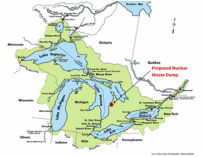 Location of proposed Ontario Power Generation nuclear waste repository near Lake Huron. (Image credit: cleanwateraction.org) Location of proposed Ontario Power Generation nuclear waste repository near Lake Huron. (Image credit: cleanwateraction.org) LWVLMR thanks and salutes the Leagues of Women Voters of Downers Grove/Woodridge/Lisle, Elmhurst, Glen Ellyn, Naperville, Roselle/ Bloomingdale, and Wheaton, for taking action on a matter to safeguard the Great Lakes. In February, these Leagues jointly testified in favor of a proposed DuPage County, IL resolution which opposed development of a deep geological repository for low and medium level nuclear waste in Canada. The proposed site is about 1 km (that's about .6 miles) from the shores of Lake Huron.
Opposition to the proposed waste site is coming from all levels here in the Great Lakes region. Numerous communities throughout the Great Lakes Basin - on both sides of the border - have also passed resolutions. 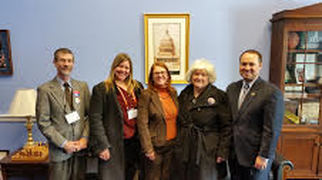 Bruce Allen & Abigail King from Save Maumee, Debbie Chubb & Jeanette Neagu, LWV of Indiana, and Rep. Marlin Stutzman (IN-3). Feb. 26, 2015 Bruce Allen & Abigail King from Save Maumee, Debbie Chubb & Jeanette Neagu, LWV of Indiana, and Rep. Marlin Stutzman (IN-3). Feb. 26, 2015 I have just returned from Washington, D.C. where Debbie Chub and I represented League of Women Voters of Indiana at Great Lakes Day. This is an annual event where citizen lobbyists from throughout the country come to address the need for continuation of federally funded programs to protect the Great Lakes from pollution and to restore the Areas of Concern, and discuss other important concerns about the health of the Great Lakes.
LWVIN is a member of Healing our Waters, the Coalition that organizes Great Lakes Day. The Indiana team was able to meet with Representatives Stutzman and Walorski as well as staff from the offices of Representatives Carson, Visclosky, Donnelly and Coats. The other Indiana Representatives did not respond to meeting requests. The first day we were updated on all the marvelous projects that have been completed because of Great Lakes Restoration Funding. Please take a look at the Great Lakes, Great Impact website from the Joyce Foundation which gives you more information about the Great Lakes Restoration Initiative (GLRI). We would appreciate any efforts you can make to gain your legislator’s support for $300 million federal dollars to continue the work of restoring the Great Lakes. Healing Our Waters has put out an action alert with valuable information about how individuals can help. Debbie and I were also able to attend a most informative hearing called by Representative John Conyers (MI-3) and the Unitarian Universalist Service Committee on how federal, state and local agencies can work together to ensure universal access to quality drinking water. The hearing was supported by Representatives Charlie Rangel (NY-13), Earl Blumenauer (OR-3), Brenda Lawrence (MI-14), Debbie Dingell (MI-12), and Sheila Jackson Lee (TX-18). This link describes the problem addressed: http://www.huffingtonpost.com/john-conyers/drinking-water-a-human-ri_b_6754308.html Representative Stutzman is a farmer and was most amenable to our suggestions on the necessity of reducing nutrient outflows from farm lands into our waterways. We expected to spend fifteen minutes with a staff member and instead spent forty minutes with him. The trip was very valuable. Jeanette Neagu, Chair Natural Resources Committee LWV of Indiana 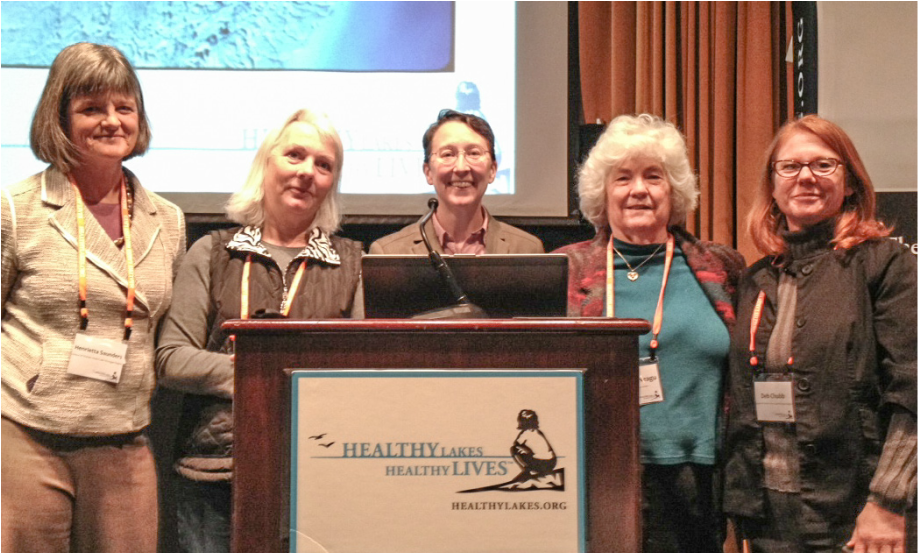 LWVLMR President Henrietta Saunders, Laurie Morse of LWV Glencoe, IL, Jill Ryan of Freshwater Future, and Jeanette Neagu and Deborah Chubb, both LWV La Porte County, IN, in Washington DC to give voice to the importance of the lakes to voters in the Great Lakes states. Today, League members join other advocates on Capitol Hill to share the need for continued restoration of the Great Lakes. They will be discussing clean water protection, runoff pollution, and invasive species, and funding of programs like the Great Lakes Restoration Initiative, the Regional Conservation Partnership Program, and the Clean Water State Revolving Fund, all of which are critical to the health of the lakes.
LWVLMR is a member of the Healing Our Waters - Great Lakes Coalition, which organizes Great Lakes Day every year.
The delegation also adopted a resolution honoring Vice President Janet Greenwald, absent due to illness, and the longest serving board member. Indiana delegate Jeanette Neagu shared a gift that will be presented to Janet along with a signed copy of the resolution.
Finally, several advocacy opportunities were offered to local Leagues and individuals, then the meeting adjourned to a reception at the "Top of the Park." |
Archives
December 2017
Categories
All
|


 RSS Feed